
Description
Information Architecture: 1st cycle studies
At this degree programme you will learn how to design information spaces. You will learn how to:
- collect, organise and analyse data and information,
- provide it with clear and understandable names,
- present it in graphical form,
- search for it in reliable sources and share it with others,
- design and create digital products using graphics programs and prototyping tools,
- plan the information space so that it is clear and tailored to the needs of users,
- create navigation and search engines on websites and intranet (private) sites.
Information architecture combines knowledge from the humanities, social sciences and technology. It is a good choice if you think humanistically and use digital tools consciously
Rekrutacja rozpoczyna się 2 czerwca
Curriculum
Link to the curriculum and study plan
Duration of studies: 6 semesters
Number of ECTS credits: 180
Selected degree programme courses:
- Effective Information Search – shows how to search for and evaluate information.
- Information Analysis and Visualisation – teaches how to analyse data and charts.
- Design Thinking – teaches creative problem-solving.
- Information Security – teaches how to protect data and information.
- Digital Accessibility – teaches how to design accessible content.
Forms of classes:
- lectures
- practicals
laboratory classes – practical meetings in the workshops
Major
As a student of Information Architecture, you do not choose a major
Graduation Requirements
In order to take the diploma examination, you have to:
- achieve the learning outcomes specified in the curriculum,
- know a foreign language,
- receive a positive thesis grade.
You finish your studies with a diploma exam with at least a ‘satisfactory’ grade. Upon completing your studies, you will receive an engineering degree that confirms your qualifications.
Detailed information on the rules for awarding diplomas and the requirements for the diploma thesis can be found in the Rules and Regulations of Studies at the University of Silesia and the Diploma Award Regulations.
Admission Process
The admission process for studies at the University of Silesia is carried out via the Online Application System at irk.us.edu.pl (IRK).
Use IRK to enrol in your studies and find all the information you need. What the admission process looks like, what the deadlines are, how much the admission fee is and what documents you need to submit.
Questions? Send an email to the International Admissions Office or visit rekrutacja.us.edu.pl and irk.us.edu.pl
Admission Requirements
Studia stacjonarne pierwszego stopnia
Admission to the programme is determined by your Matura exam result. We take the written examination in the selected subjects:
Polish language | Modern Foreign Language | Mathematicska |
weight = 60% | weight = 20% | weight = 20% |
Point Thresholds
In accordance with the admission criteria, no programme at the University of Silesia has got a predetermined point threshold.
Committees create ranking lists during the admission process. Admission thresholds change every year, as they depend on the number of candidates, their high school graduation exam results, and the applicable qualification rules.
Additional Criteria
To begin the degree programme, you do not have to meet any other criteria.
Traineeships and Internships
Information Architecture programme does not include work placements or internships.
Cooperation
The Faculty of Humanities supports your trips under the Erasmus+ programme and cooperation with foreign universities and information centres. You can complete an internship abroad at various institutions or partially study at one of the partner universities in 31 programme countries, including:
- Bulgaria,
- Croatia,
- Czechia,
- Estonia,
- France,
- Lithuania,
- Latvia,
- North Macedonia,
- Germany,
- Portugal,
- Romania,
- Slovakia,
- Türkiye,
- Italy.
Contact
Dean’s office
Our office handles matters concerning document submission and university enrollment, degree programmes and curricula, course registration, student ID cards, tuition fees, and USOSweb login issues
International Admissions Office
tel. +48 32 359 22 72
tel. +48 32 359 22 73
e-mail: admission@us.edu.pl
Our office handles matters concerning the admission process of foreign nationals (candidates without Polish citizenship): including the course of the university admission process, formalities related to required educational credentials (legalisation and apostille), and issuance of certificates of qualification for study.
Faculty Admission Committee
You can find contact details in the Online Application System by selecting the degree programme of your interest:
Kontakt znajdziesz w systemie IRK, wybierając interesujący Cię kierunek:
https://irk.us.edu.pl/pl/.
Our office handles all admissions matters, including acceptance for studies, grade conversion within the Online Application System, navigating the admission process, reviewing entry criteria, and managing required documentation.
-
General information
-
Faculty
Faculty of Humanities
-
Study level
1st cycle
-
Form of studies
full-time studies
-
Study profile
general academic
-
Language of instruction
Polish
-
Degree
Bachelor’s degree
-
Field of science
culture and religion studies
-
Cities
Katowice
Co nas wyróżnia
01.
Warsztaty
Nauczysz się projektowania stron, UX, grafiki i webwritingu. To konkretne umiejętności, których szuka nowoczesny rynek pracy.
02.
Specjalizacja
Dzięki zajęciom English for Digital Designers opanujesz fachową terminologię niezbędną w świecie projektowania produktów IT.
03.
Wiedza ekspercka
Ucz się od najlepszych! Nasi wykładowcy i wykładowczynie stworzyli nagradzany, bezpłatny „Angielsko-polski słownik IA, UX & SEO”.
04.
Mobilność
Jako osoba studiująca możesz zrealizować zagraniczne praktyki lub część studiów w 31 krajach w ramach popularnego programu Erasmus+.
Graduate zone
Career Paths
As an information architect, you will design and organise websites. Thanks to your work, users will quickly find the information they need. You will create navigation and search systems, add graphics, and maintain the appearance and consistency of the website. You will also become a specialist in testing the usability of websites and their improvement for search engines (SEO).
Where can I find employment
After graduation, you can work in:
Information architecture
Web design
Website content management
User interface and interaction design (UI & IxD)
User experience research and design (UX)
Computer graphics design
Social media communication
Digital publishing and new media editing
Graduate Knowledge
- After completing your studies, you know information architecture and understand its connections with other fields of study.
- You can search, organise, process, protect, analyse and present data and information, including visually.
- You know the principles, methods and tools of visual design.
- You can create content structures for various spaces and information objects, while ensuring usability, functionality, and aesthetics.
- You know the sources of information, their types and quality, and you can describe, organise and share content in information systems.
- You know how to edit different texts depending on the audience, medium, and publishing environment.
- You understand the psychological, social and cultural functioning of humans in e-society and their information needs.
- You know the principles of industrial property protection and copyright law.
- You have knowledge of entrepreneurship, systems, methods and processes for managing and distributing products and services, especially digital ones.
Graduate Skills
- After the studies, you select sources and check their credibility, searching for information.
- You use knowledge from other fields and solve problems.
- You take psychological and social factors into account when designing digital products.
- You recognise risks and protect systems and documents.
- You process data, analyse it and display the results in programs.
- You create digital products, plan spaces and take care of appearance.
- You check the operation of systems and services.
- You create messages and arguments based on verified sources.
- You communicate in a foreign language at B2 level.
- You work collaboratively in a group, lead a team and plan work.
- You learn independently and develop your skills
Social Skills
- After graduation, you observe the progress of science and changes in technology. You evaluate your knowledge and are eager to learn new things.
- You solve problems, organise information, and present it in a clear and attractive way.
- You understand your role as an information architect. You contribute to society and communicate effectively with others.
Poznaj nas lepiej
Fanpage kierunku
Fanpage Wydziału
Koło naukowe
Kulisy naszych zajęć
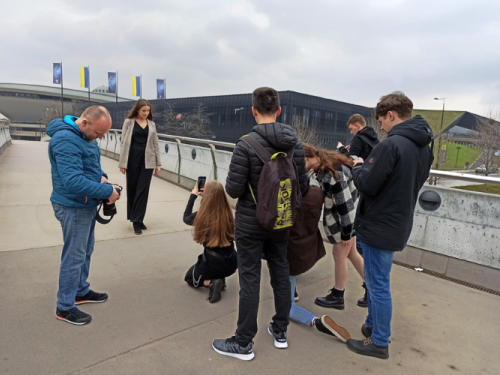
Zajęcia praktyczne
Fotografia cyfrowa to nie tylko teoria. W terenie przećwiczysz pracę z portretem i światłem, a podczas kursów opanujesz obsługę Photoshopa oraz WordPressa – narzędzi niezbędnych w pracy twórczej.
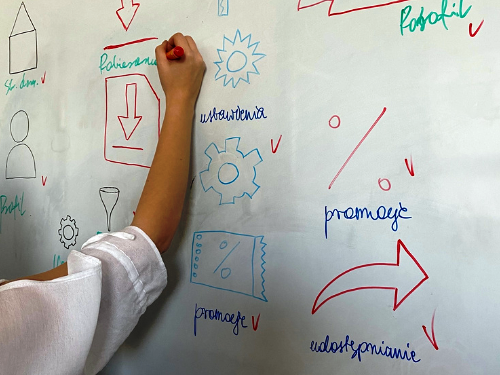
Prototypowanie stron i aplikacji
Zanim powstanie gotowy produkt, czas na projekt. Na zajęciach nauczysz się tworzyć makiety i prototypy stron oraz aplikacji mobilnych. Zaprojektujesz też intuicyjne systemy nawigacji, etykiety i ikony.
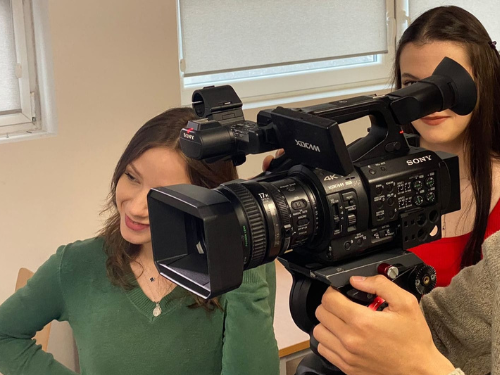
Public Relations w praktyce
Warsztaty z PR prowadzi praktyk – Sławomir Gruszka, Rzecznik prasowy Urzędu Marszałkowskiego. W ramach zajęć sprawdzisz się w realnych zadaniach, m.in. podczas organizacji i prowadzenia konferencji prasowych.
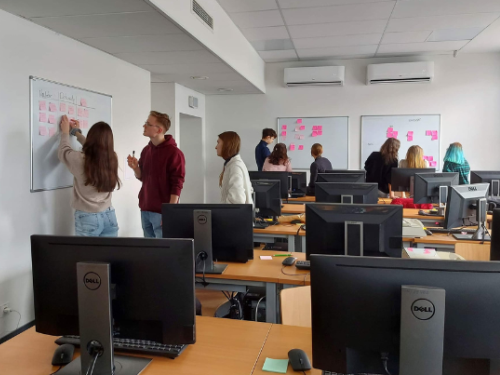
Architektura informacji
Jak projektować etykiety, które każdy zrozumie? Dzięki technice sortowania kart nauczysz się właściwie grupować informacje i badać, w jaki sposób odbiorcy kategoryzują dane w świecie cyfrowym.

Ambasadorka kierunku
dr Joanna Wróbel
Moją pasją jest komunikacja i współpraca. W trakcie zajęć zanurzam studentów w realne doświadczenie biznesowe. Opiekujemy się klientem wykonując dla niego zlecenie: projekt strony, kampanię wizerunkową, wizualizację w Figmie, analitykę SEO. Uważam, że współpraca jest kompetencją przyszłości. Na niej opieram życie osobiste i zawodowe.