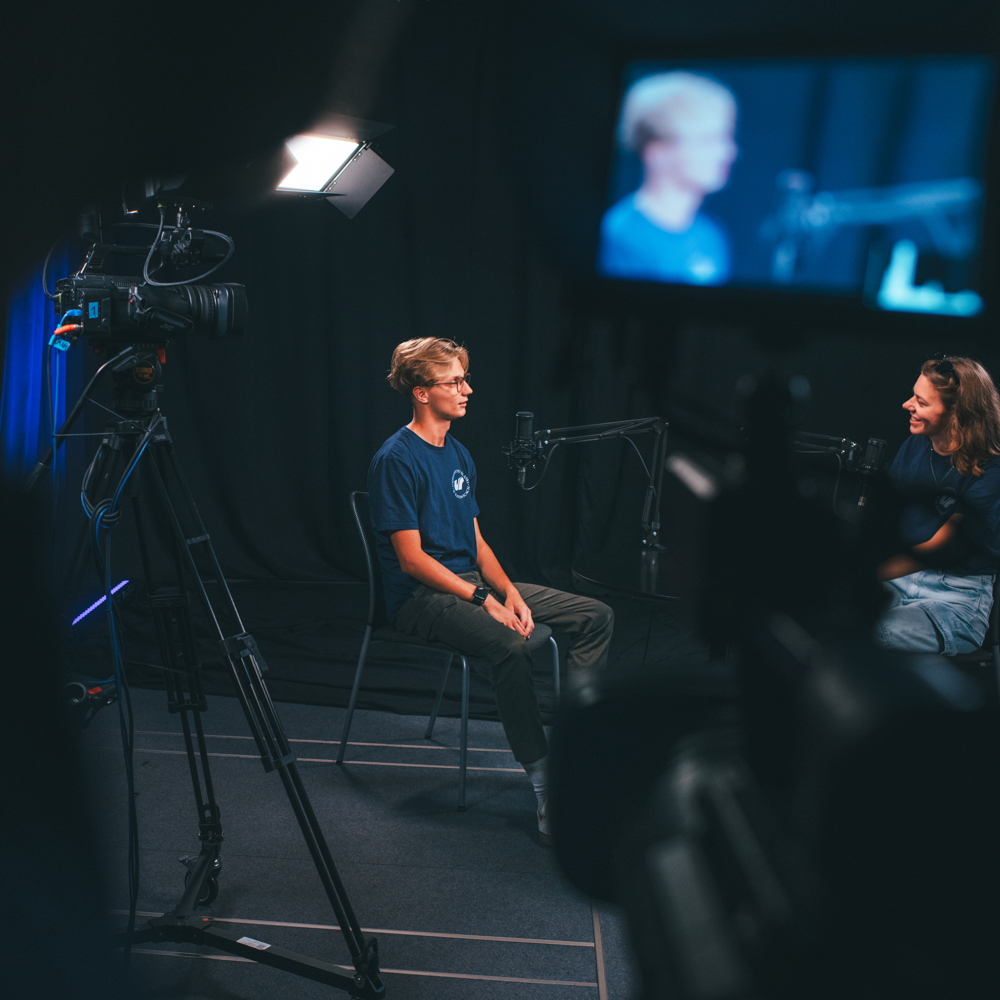
Description
Do you want to work in the media? Are you interested in communication, the internet and the world of information? Choose a degree programme with a future and study at the University of Silesia!
Studies in Journalism and Social Communication will prepare you for a career in the media and in professions related to communication and public image. You will learn to operate in a world where the press, radio, television and the internet are becoming increasingly intertwined.
During your studies:
- you’ll learn the principles of working in various media,
- you’ll discover how the media influence people and society,
- you’ll acquire the skills needed in PR, advertising and promotion,
- you’ll learn to convey information in a clear and engaging way,
- you’ll develop your knowledge of a foreign language to B2 level.
You’ll learn from industry professionals and gain skills that are valuable in the job market. You’ll understand the media landscape, the impact of information on society and dynamic technological changes. This will enable you to shape public debate and operate effectively in times of rapid socio-political change.
Upon graduation, you will be an expert in modern media. You can work, for example, as:
- a journalist in the press, on the radio, on television or online,
- a PR, promotion or advertising specialist,
- a press officer,
- a member of communications and marketing teams,
- a crisis communications specialist,
- a communication trainer or media educator,
- an image consultant for institutions and companies.
Rekrutacja rozpoczyna się 2 czerwca
Curriculum
Link to the curriculum and study plan
Duration of studies: 6 semesters (1st cycle), 4 semesters (2nd cycle)
Number of ECTS points: 180 (1st cycle), 120 (2nd cycle)
Selected modules in Journalism and Social Communication – 1st cycle:
- Journalistic Ethics – introduces students to the theory and practice of journalism.
- Media Sociology – explains the mechanisms that influence the behaviour of individuals and social groups.
- Public Relations – teaches how to manage communication within companies, institutions and organisations.
- Journalistic Information Sources – demonstrates where to source information and what regulations apply when producing journalistic content.
Selected modules in Journalism and Social Communication – 2nd cycle:
- Local and Community Media – demonstrate how media aimed at specific communities operate.
- Journalism Workshop – teaches the practical skills required for journalistic work.
- Marketing and Advertising – explains the basic categories, models and concepts of marketing and advertising.
- Online Journalism – analyses online journalistic genres.
Forms of classes:
- lectures
- practicals,
- laboratories – putting knowledge into practice
- tutorials – group discussions
- seminars – preparation for writing a thesis
Majors
You do not choose a major in this programme. Instead, you explore all types of media – print, radio, television, online and social media.
The programme offers a wide range of practical classes that will help you acquire the specific skills needed in the media, journalism or other media-related professions. This will make it easier for you to decide which direction you wish to take.
In addition to core courses, you can also choose to take classes from other fields. You have the opportunity to gain additional skills in such areas as:
- digital world,
- frontiers of science,
- creative expression and critical thinking,
- health and personal development,
- civil society and entrepreneurship,
- natural environment and technology.
Graduation requirements
To take the final examination, you must:
- pass all the learning outcomes specified in the curriculum,
- confirm the required knowledge of a foreign language,
- obtain a positive grade for your thesis.
You complete your studies when you pass the diploma examination. After completing your studies, you will receive a higher education diploma confirming your qualifications and readiness to enter the labour market.
Detailed information on the rules for awarding diplomas and the requirements for the diploma thesis can be found in the Rules and Regulations of Studies at the University of Silesia and the Diploma Award Regulations.
Admission
Admission to studies at the University of Silesia is conducted via the Online Application System (IRK): irk.us.edu.pl.
In IRK, you can enrol for studies and check all the necessary information, including what the admission process looks like, what the deadlines are, how much the admission fee is and what documents you need to submit.
Any questions? Send an email to the Education Department or visit rekrutacja.us.edu.pl and irk.us.edu.pl.
Admission requirements
Full-time 1st cycle studies
| The selection process includes an examination of school-leaving certificates — results from the subjects listed below, taken as part of the written component of the school-leaving examination, are taken into account: | ||
| Polish language | Foreign modern language | Elective subject: history, civic studies, philosophy, art history, music history, ancient culture and Latin language, mathematics, Polish, a modern foreign language |
| weighting = 30% | weighting = 30% | weighting = 40% |
| ||
Part-time 1st cycle degree programmes
Admission to studies is based on submitting the required documents upon prior registration in the Online Application System (IRK). |
Full-time 2nd cycle studies
Admission to studies is based on submitting the required documents upon prior registration in the Online Application System (IRK). If the number of candidates exceeds the admission quota, admission is determined by the candidate’s position on the ranking list, which is drawn up on the basis of the average of all first-cycle study grades, according to the following rules:
|
Part-time 2nd cycle studies
Admission to studies is based on submitting the required documents upon prior registration in the Online Application System (IRK). If the number of candidates exceeds the admission quota, admission is determined by the candidate’s position on the ranking list, which is drawn up on the basis of the average of all first-cycle study grades, according to the following rules:
|
Point thresholds
At the University of Silesia, we do not set minimum point thresholds for any field of study.
Committees create ranking lists during the admission process. Admission thresholds change every year, as they depend on the number of candidates, their high school graduation exam results, and the applicable qualification rules.
Additional criteria
You do not need to meet any additional criteria to study this degree programme.
Internships and work experience
During the 1st cycle studies, you will undertake 320 hours of internships, which take place in the 4th and 6th semesters.
In the 2nd cycle studies, you will undertake 160 hours of internships, which begin after the 1st semester. You must complete them by the end of the 4th semester.
During your internships:
- you learn how editorial offices, the media, and public and private institutions operate,
- you learn to work in a team, organise tasks and make decisions,
- you gain the experience needed to enter the job market.
- You will undertake your internships in places such as:
- Polska Press Sp. z o.o. – e.g. the editorial offices of Dziennik Zachodni and other publications,
- Polskie Radio Katowice,
- Polish Television in Katowice – e.g. TVP3 Katowice,
- TVN24 in Katowice,
- the editorial offices of local, online, national and regional media outlets,
- advertising and public relations agencies,
- corporate communications departments within companies, and government and local authority offices.
Cooperation
As part of the Erasmus+ programme, you have the opportunity to:
- undertake an internship in a city of your choice from among the 31 countries participating in the programme,
- complete part of your studies at a partner university.
We cooperate with institutions in, among others, Bulgaria, the Czech Republic, Cyprus, Estonia, France, Spain, Lithuania, Germany, and Portugal.
Contact
Dean’s Office
Our office handles matters concerning document submission and university enrollment, degree programmes and curricula, course registration, student ID cards, tuition fees, and USOSweb login issues.
International Admissions Office
tel. +48 32 359 22 72
tel. +48 32 359 22 73
e-mail: admission@us.edu.pl
Our office handles matters concerning the admission process of foreign nationals (candidates without Polish citizenship): including the course of the university admission process, formalities related to required educational credentials (legalisation and apostille), and issuance of certificates of qualification for study.
Faculty Admission Committee
You can find the details in the Online Application System by selecting the degree programme of your interest at https://irk.us.edu.pl/pl/.
Our office handles all admissions matters, including qualification for study, grade conversion within the Online Application System, navigating the admission process, reviewing entry criteria, and managing required documentation.
-
General information
-
Faculty
Faculty of Natural Sciences
-
Study level
1st cycle, 2nd cycle
-
Form of studies
full-time studies, part-time studies
-
Study profile
general academic
-
Language of instruction
Polish
-
Degree
Bachelor’s degree, Master’s degree
-
Field of science
communication and media studies
-
Cities
Katowice
What makes us stand out?
01.
Flexibility
You create your own learning path thanks to a variety of teaching methods and the informed choice of modules, academic supervisors and specialisations.
02.
Practical experience
We focus on practical experience: internships in companies, workshops and sessions with experts. You will gain an understanding of the realities of the labour market and the principles of research commercialisation.
03.
Development
You’ll carry out your own research projects under the guidance of mentors. We support research societies and exchange trips through the ERASMUS+ and MOST programmes.
04.
Quality
We provide education of the highest standard, as confirmed by PKA accreditation. The classes are taught by highly qualified staff with a proven track record of academic achievement.
Graduate zone
Career paths
After completing your degree programme, you can continue your education as part of 2nd cycle studies.
After obtaining your Master’s degree, you can continue your studies at postgraduate and doctoral levels.
If you wish to pursue a professional career, you have many opportunities. You could work, for example, as:
- a journalist in various media, including the press, radio, television and the internet,
- a member of an advertising, promotion or public relations department,
- a specialist in media education,
- a manager of media organisations,
- a media market and public opinion research analyst.
Graduate Knowledge
- You understand the role of the media and social communication, and their links to other fields of study.
- You are familiar with the fundamentals of effective communication and understand how it influences social life, institutions and interpersonal interactions.
- You are able to outline the principles governing the political system and other socio-political institutions.
- You analyse social structures and communication processes using appropriate research methods and tools.
- You understand how communication systems operate at local and international levels.
- You are familiar with current cultural phenomena and the workings of cultural institutions.
- You apply ethical principles in journalism and related professions, and you are familiar with copyright and media law.
- You understand the basics of entrepreneurship and can apply your media knowledge in your professional work.
- You plan and carry out the production of journalistic content – film, television and radio – both in the studio and on location.
- In addition, upon completion of the 2nd cycle studies:
- You are familiar with research methods in media and communication, as well as the management of advertising and news organisations.
- You understand how editorial offices and media markets operate in Poland and abroad.
- You understand the role of communication in culture and social life.
- You understand how the media shape public opinion.
Graduate skills
- You analyse and interpret political, legal, economic and cultural phenomena and understand their significance in social communication.
- You conduct media research, analyse the results and draw conclusions.
- You select appropriate research methods for communication-related projects.
- You prepare and edit informational materials and articles.
- You propose new communication solutions.
- You apply ethical principles and professional standards in journalism, PR and advertising, anticipating the consequences of your actions in interpersonal, group and mass communication.
- You work in a team, assign tasks and achieve shared professional goals.
- You plan and carry out the production of journalistic materials, including editing and post-production.
- You work in interdisciplinary teams and use modern technical tools.
- You shape your own image and understand the principles of self-presentation. You manage stress during public speaking.
- You communicate in a foreign language at B2 level and use specialist terminology.
Social skills
- You analyse knowledge and develop professional communication skills.
- You apply your knowledge in professional practice.
- You gain confidence when speaking in front of a camera and a microphone.
- You apply the principles of journalistic ethics and those of related professions. You adhere to ethical principles when designing, conducting and interpreting research.
- You critically evaluate the media and actively participate in public discourse.
- You plan and carry out communication activities.
- You act for the benefit of various social groups and institutions.
- You think creatively and entrepreneurially, combining knowledge from various fields and independently developing your skills.