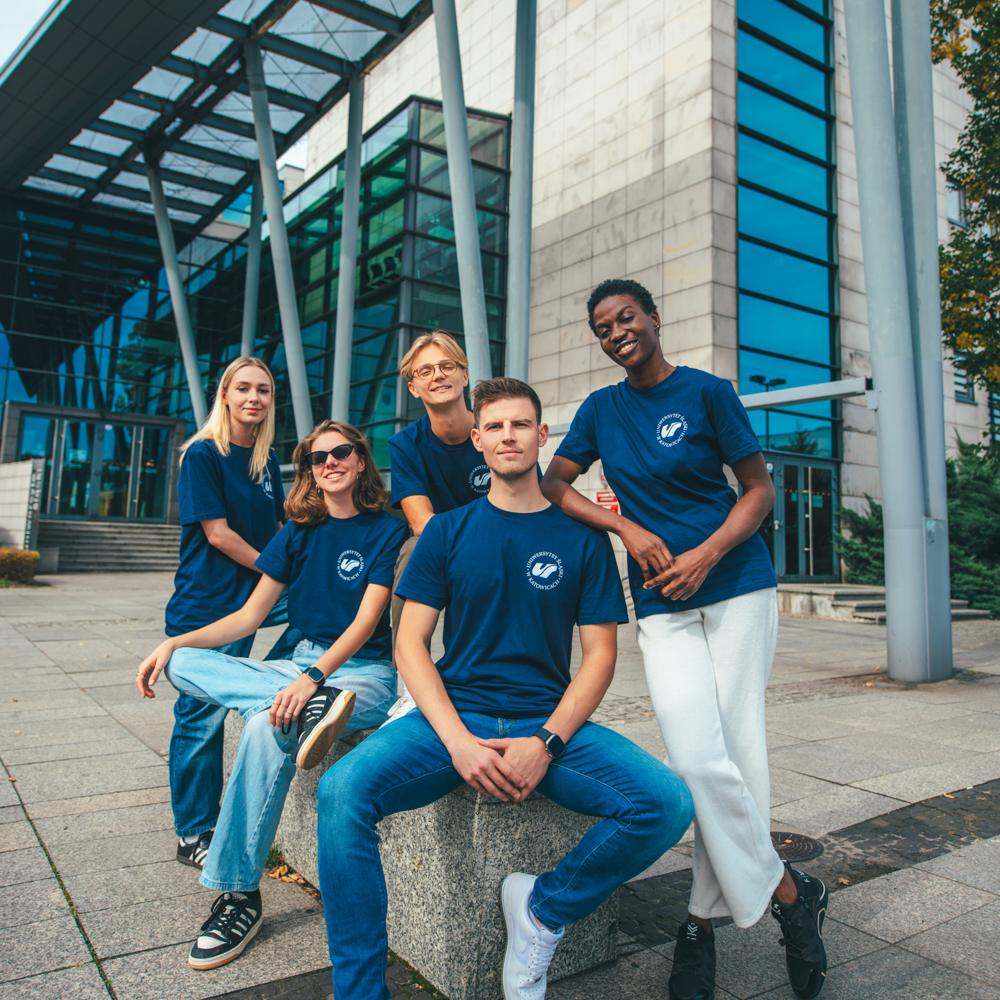
Description
Materials Science and Engineering – studies in English
Would you like to know what engine turbines are made of? How modern bone implants are created? Is it possible to design a material that is both super-strong and environmentally friendly? You can discover answers to all these questions by studying Materials Science and Engineering. An additional advantage is the fact that this degree programme is conducted in English. This not only gives you specialist knowledge, but also increases your chances of finding an attractive job abroad.
You will learn how to research, design and manufacture modern materials used in aviation, automotive, energy and medicine industries. You will learn how to identify defective components, improve their properties, or develop completely new materials tailored to specific needs.
The Materials Science and Engineering degree programme lasts 7 semesters. After completing the first cycle, you will receive an engineering degree, and then you can continue your studies, also in English, at the second cycle. Completing this programme opens up many opportunities: you can conduct research, work on innovative technologies, and have a real impact on the development of modern industry.
Rekrutacja rozpoczyna się 2 czerwca
Curriculum
Link to the curriculum and study plan
Duration of studies: 7 semesters
Number of ECTS credits: 210
Selected courses:
- Unconventional biomaterial
- Materials chemistry
- Applied mathematics
- Application software
- Engineering design and graphics
- Computer-aided design (CAD)
- Crystallography
- Mathematical and physical basics of materials science
- Programming languages
- Implants and artificial organs
- Prototyping and 3D printing
- Introduction to biomaterials engineering
- Materials databases
Forms of classes:
- lectures
- practicals
- seminars – classes based on group discussions
- laboratory classes
- language courses
- workshops
- tutoring
- internship
Majors
Materials Science and Engineering – 1st cycle studies
During your 1st cycle studies, you can choose from two majors:
- Materials Science,
- Biomaterials.
If you want to design and create the materials of the future, choose Materials Science as your major. Here you will gain the necessary knowledge and skills needed to work with modern materials—from nanotechnology and metallurgy to chemistry and physics.
You will learn how to evaluate materials, check their properties and apply them in practice—in industry or laboratories. You will also learn how to use the latest IT tools and communicate effectively with your team. After completing the Materials Science major, you will be able to collaborate with engineers and scientists, implement new technologies, and participate in innovative projects.
If you want to design implants, artificial bones, and medical materials that help people and animals, choose the Biomaterials major. Here you will learn, among other things, how to:
- create modern and safe biomaterials,
- test and improve implants and artificial organs,
- bring your ideas from the laboratory to the market,
- combine science with practice in medicine, dentistry and veterinary medicine.
After graduation, you can work in laboratories, medical companies, research institutes and on innovative projects that really change lives.
Graduation requirements
Materials Science and Engineering – 1st cycle studies
Graduation
In order to take the diploma examination, you have to:
- pass all subjects included in the curriculum,
- confirm knowledge of a foreign language,
- receive a positive thesis grade.
You graduate when you pass your final examination. Upon completing your studies, you will receive an engineering degree that confirms your qualifications. Details regarding the diploma thesis and examination can be found in the Rules and Regulations of Studies at the University of Silesia.
Admission process
The admission process for studies at the University of Silesia is carried out via the Online Application System at irk.us.edu.pl (IRK).
Use IRK to enrol in your studies and find all the information you need. You will learn about the admission process, the deadlines, the enrolment fee, and all the documents you need to submit.
Questions? Feel free to write to the International Admissions Office or visit rekrutacja.us.edu.pl and irk.us.edu.pl.
Admission rules for the academic year 2026/2027
Materials Science and Engineering: full-time 1st cycle Engineer’s degree – taught in English
The selection process includes an examination of school-leaving certificates – results from the subjects listed below, taken as part of the written component of the school-leaving examination, are taken into account:
| Mathematics | One subject to choose: biology, chemistry, physics and astronomy, computer science, mathematics or results of the vocational examinations in the subject taught at technician level | Modern foreign language |
| weightning = 60% | weightning = 30% | weightning = 10% |
- Only results from diplomas confirming vocational qualifications or vocational diplomas issued exclusively within the Polish education system are taken into account. In the case of a diploma confirming vocational qualifications, the best result – from either the written or practical part of the examination – will be taken into account. In the case of a vocational diploma, the final result of the vocational examinations will be taken into account.
- The result for a subject at the basic level is multiplied by a conversion factor of 0.5; for the advanced level, by a conversion factor of 1; and then by the subject’s weighting.
- The grade for vocational examinations in a trade taught at technician level is multiplied by a conversion factor of 0.7, and then by the subject’s weighting.
- If a candidate sat a particular subject at both levels in the secondary school-leaving examination, the result from the level which, after applying the conversion factor and weighting, is more favourable to the candidate will be taken into account.
- The same subject may be taken into account twice in the assessment, provided that the candidate took it at two different levels: basic and advanced and that the result from the same level is not taken into account a second time.
- The result from a bilingual examination in a modern foreign language will be converted to an ‘advanced’ level result by multiplying it by 4/3; the maximum result at the advanced level may not exceed 100% (if it is higher, it is set to 100%).
- If a candidate did not take a particular subject in the school-leaving examination, they will receive zero points for that subject, but may still take part in the admission process.
- Detailed rules for the admission of candidates with the old Matura exam are set out in Section 14 of the resolution.
- Admission to studies is determined by a candidate’s position on the ranking list, which is drawn up on the basis of the total number of points obtained.
- If the admission limit is not achieved, all candidates with a result (WK) higher than 0 will be admitted.
The candidate has to submit a relevant medical certificate on the lack of medical contraindications to take up studies in this programme.
Admission rules for the academic year 2027/2028
Materials Science and Engineering: full-time 1st cycle Engineer’s degree – taught in English
The selection process includes an examination of school-leaving certificates – results from the subjects listed below, taken as part of the written component of the school-leaving examination, are taken into account:
| Mathematics | One subject to choose: biology, chemistry, physics and astronomy, computer science, mathematics or results of the vocational examinations in the subject taught at technician level | Modern foreign language |
| weightning = 60% | weightning = 30% | weightning = 10% |
- Only results from diplomas confirming vocational qualifications or vocational diplomas issued exclusively within the Polish education system are taken into account. In the case of a diploma confirming vocational qualifications, the best result – from either the written or practical part of the examination – will be taken into account. In the case of a vocational diploma, the final result of the vocational examinations will be taken into account.
- The result for a subject at the basic level is multiplied by a conversion factor of 0.5; for the advanced level, by a conversion factor of 1; and then by the subject’s weighting.
- The grade for vocational examinations in a trade taught at technician level is multiplied by a conversion factor of 0.7, and then by the subject’s weighting.
- If a candidate sat a particular subject at both levels in the secondary school-leaving examination, the result from the level which, after applying the conversion factor and weighting, is more favourable to the candidate will be taken into account.
- The same subject may be taken into account twice in the assessment, provided that the candidate took it at two different levels: basic and advanced and that the result from the same level is not taken into account a second time.
- The result from a bilingual examination in a modern foreign language will be converted to an ‘advanced’ level result by multiplying it by 4/3; the maximum result at the advanced level may not exceed 100% (if it is higher, it is set to 100%).
- If a candidate did not take a particular subject in the school-leaving examination, they will receive zero points for that subject, but may still take part in the admission process.
- Detailed rules for the admission of candidates with the old Matura exam are set out in Section 14 of the resolution.
- Admission to studies is determined by a candidate’s position on the ranking list, which is drawn up on the basis of the total number of points obtained.
- If the admission limit is not achieved, all candidates with a result (WK) higher than 0 will be admitted.
The candidate has to submit a relevant medical certificate on the lack of medical contraindications to take up studies in this programme.
Point thresholds
We do not set minimum point thresholds for any field of study at the University of Silesia.
Committees create ranking lists during the admission process. Admission thresholds vary every year, as they depend on the number of candidates, their high school graduation exam results, and the applicable qualification rules.
Additional criteria
To begin your studies in this programme, please provide a bill of health from your doctor, confirming that you are able to participate in it and that there are no health contraindications.
Internships
In your second and third years, you will complete professional internships—you can choose a company yourself or use our partner database. You can also participate in additional internships in Poland and abroad. Your internship supervisor and the University of Silesia Career Office will help you find the best place for you to gain professional experience.
Cooperation
More information soon.
Contact
Dean’s Office
Faculty Website: contacts
Our office handles matters concerning document submission and university enrolment, degree programmes and curricula, course registration, student ID cards, tuition fees, and USOSweb login issues
International Admissions Office
tel. +48 32 359 22 72
tel. +48 32 359 22 73
e-mail: admission@us.edu.pl
Our office handles matters concerning the admission process of foreign nationals (candidates without Polish citizenship): including the course of the university admission process, formalities related to required educational credentials (legalisation and apostille), and issuance of certificates of qualification for study.
Faculty Admission Committee
You can find the details in the Online Application System by selecting the degree programme of your interest at
https://irk.us.edu.pl/pl/.
Our office handles all admissions matters, including acceptance for studies, grade conversion within the Online Application System, navigating the admission process, reviewing entry criteria, and managing required documentation.
-
General information
-
Faculty
Faculty of Science and Technology
-
Study level
1st cycle
-
Form of studies
full-time studies
-
Study profile
general academic
-
Language of instruction
English
-
Degree
Engineer’s degree
-
Field of science
materials science and engineering
-
Cities
Chorzów
What makes us stand out
01.
Flexibility
You create your own path thanks to a variety of teaching methods and the freedom to choose your classes, academic supervisors and specialisations.
02.
Practical experience
We focus on practical experience: work placements, workshops and classes with experts. You’ll gain an understanding of the realities of the job market and the principles of research commercialisation.
03.
Development
You carry out your own research projects under the guidance of mentors. We provide support for student research groups and exchange trips through the ERASMUS+ and MOST programmes.
04.
QUALITY
We provide the highest level of education, as confirmed by Polish Accreditation Committee. Classes are taught by highly qualified faculty with recognised scientific achievements.
Graduate zone
Career paths
After completing a degree in Materials Science and Engineering, you will be able to create and test the materials of the future. Your work opportunities after graduation will include:
- industry: metallurgy, transport, energy sector, construction, automotive industry, aviation
- research laboratories: testing materials, developing new ones and improving their quality
- design and quality control offices: designing products and ensuring that they are durable and safe
- production management: supervising processes and introducing improvements
If you dream of science and research, you can also continue your career at the Doctoral School and work in laboratories and institutes.
Graduate knowledge
- Upon completing your studies, you will know and understand the mathematics, physics and chemistry needed to describe phenomena and processes in materials engineering and materials manufacturing.
- You will have a structured understanding of different groups of engineering materials and know where and how they are used now and where and how they will be used in the future.
- You will understand how the structure of a material affects its properties, which is fundamental to designing, manufacturing and modelling materials with specific characteristics.
- You will be familiar with production methods and techniques that can be used to shape the appearance, structure and properties of materials.
- You will know how to examine materials and use scientific and research equipment to assess their properties.
- You will understand how materials behave over time and how to prevent their deterioration in equipment and structures.
- You will be able to select materials for engineering structures, understanding how their structure and properties affect durability.
- You will be familiar with the latest trends in materials for industry and medicine, as well as modern technologies for their production, in line with the principles of sustainable development.
- You will be familiar with technical drawing and engineering graphics, and you will be able to use computer programmes for design and engineering work.
- You will know how to use information and communication technologies as well as IT tools in your work as an engineer.
- You will understand the principles of industrial property protection, copyright and intellectual property knowledge required in materials engineering.
- You will know how to develop your own business and entrepreneurship in the field of modern materials.
Graduate skills
- After completing your studies, you will be able to quickly find the information you need in books, articles, databases and other sources, combine it, understand it and draw conclusions. You will also be able to formulate your own opinions and justify them.
- You will know how to talk to others using the language of materials engineering, present different points of view, and take part in discussions, as well as debates.
- You will be able to plan your studies and work independently and work effectively in a team. You will be able to learn in a way that allows you to keep up with the rapid development of materials engineering throughout your life.
- You will be able to distinguish between different groups of engineering materials, analyse their structure and properties, and select them for specific applications.
- You will be able to use your knowledge and apply analytical, simulation and experimental methods to solve technical and engineering problems—from design to modelling materials with specific properties.
- You will be able to design a simple device, system or process typical for materials engineering, using appropriate design methods and tools.
- You will be able to prepare documentation and reports on completed tasks and present the results in the form of a presentation.
- You will know how to use IT tools and computer-aided design in your work as an engineer.
- You will be able to organise your workstation in accordance with safety and ergonomic principles.
- You will be able to communicate in English at B2 level, using engineering terminology.
Social skills
- You can think critically and know that learning never ends—you are constantly developing.
- You understand how important knowledge—both theoretical and practical—is in solving problems and you know when to ask experts for help.
- You are involved in promotional and social activities that demonstrate the importance of materials engineering.
- You are able to act professionally, responsibly and ethically, performing your duties to the highest standard.